January 2, 2021
In Korean culture, there is a old proverb, Juen Hwa We Bok, that roughly translates to transforming a prior event (Juen) that brought anger (Hwa) and/or danger (We) into a blessing (Bok). In the West, this saying is analogous to, “when life gives you lemons, make lemonade.”
A recent manifestation of Juen Hwa We Bok in my life happened at the end of 2019 during a fateful visit to LA’s best hot chicken joint, Howlin Ray’s. While waiting in their super long line, I enjoyed looking at hand-drawn, colorful pictures by children posted on a window of a neighboring store around the theme of anti-smoking. While I found the pictures endearing, due to the inertia of being a smoker since high school, I wasn’t swayed much to change my ways.
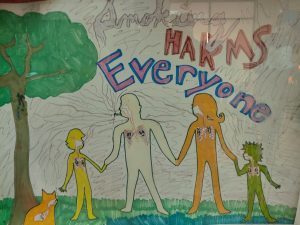
An hour or so later, overly eager to scarf down delicious hot chicken with my family, I hastily pulled out my car from the parking lot, only to be met with a loud “crunch!” To my dismay, I had dented the car parked right next to me. Not knowing how long the owner of the dented car would show, I left a note with my contact information.
On the drive home, I recall being filled with anxious and self-critical thoughts, “how could I have been so reckless!, how much is this going to cost!, my wife is going to be so mad at me!” Typical of anxiety, things ultimately did not turn out as as bad as I had feared, my wife was supportive and understanding, and even though I paid a hefty price for repairs, the situation eventually resolved itself. But feelings of regret and self-criticalness persisted.
To resolve my inner turmoil, I decided to use this negative event as an opportunity to embolden my resolve to quit smoking by mentally associating the event with the anti-smoking pictures. Now whenever I have the urge to smoke, I remind myself of the situation, which in turn strengthens my resolve and lessens the urge. I am proud to say that I did not smoke a single cigarette for the entirety of 2020. In many ways, the price I paid for the car repair was a bargain compared to my long-term health and well-being. Juen Hwa We Bok.
My “first world problem” pales in comparison to what many have had to endure and suffer through in 2020: social isolation, disruption of daily life, unemployment/financial hardships, illness, grief and loss due to COVID-19; trauma from centuries old racial injustices persistently instigated by egregious acts of police violence against our Black counterparts; discrimination against immigrants and traumatic family separations due to deportations; signs of catastrophic climate change marked by increasing wildfires, global hunger, and the extinction of non-human life forms; social unrest and political divisiveness; so on so forth.
As the year comes to an end, many appear to bid good riddance to 2020, with disdain towards the problems we faced and a wish for life to return to what was considered “normal” pre-COVID. However, in order for things to truly get better in 2021, I believe we need to see that 2020 was an important wake-up call and a valuable precipice for changes that have bearing on our collective survival.
With COVID-19, humanity faced an existential crisis analogous to the deadly World Wars and the risk of nuclear annihilation in the 20th century. Just as previous generations learned and evolved from these past crises, such as the United Nations and nuclear disarmament, we must invoke the principle of Juen Hwa We Bok in our response to the crises we faced in 2020.
We are literally in it together as COVID-19 itself does not discriminate based on our biology, although structural inequalities place certain groups more at risk than others. Challenging the divisive elements in our society, the pandemic can be a unifying force. Even prior to the pandemic, rates of loneliness has been rising. The UK even appointed a Minister of Loneliness to address the loneliness epidemic there. And as illuminated in the excellent Netflix documentary, the Social Dilemma, we have become glued to web-based algorithms that insulate us from one another, on an informational and thought-belief level. But now we all have this common experience of going through COVID together that we can bond over, by sharing, listening, and caring. I bet there are so many interesting stories to be told about this period, ranging from heart breaking to inspirational, and everything in between.
2020 also revealed and awakened us to major fault-lines in our society with regard to social injustices and systemic inequalities that have gone unresolved for too long. This new-found awareness can move us towards reconciliation and atonement with those who have long suffered under these unjust conditions. This spirit has been expressed in the Black Lives Matter movement, which has provided a voice for those oppressed. I hope that this movement can result in changes on structural and interpersonal levels that translates to actual, concrete improvements in quality of life, beyond empty rhetoric and ineffective policies.
Different from loneliness, the solitude borne from quarantine challenges us to confront what’s really important in life. Solitude can help us cultivate a practice of looking inward, which is the first step in making peace with ourselves, our loved ones, and neighbors. One of the books I read over the pandemic is Anthony Storr’s Solitude: A Return to the Self, which touts the benefits of solitude, spending time alone for self-reflection and examination, and cultivating a positive relationship with oneself, which is an essential source of human happiness. Like Whitney Houston’s classic, “Learning to love yourself, it is the greatest love of all.”
Let us not allow the pain we suffered in 2020 to be in vain. Growth requires pain, as Richard Rohr put it, “all great spirituality is about what we do with our pain.” Change is an imperative of life, going backwards to an illusory “normal” before COVID is regressive, we can only solve the problems beset us in 2020 by moving forward.
From this spirit, I hope we can manifest Juen Hwa We Bok and find purpose and meaning in the challenges faced in 2020 to help us grow and evolve into better versions of ourselves, individually and collectively, for the sake of the long-term health and well-being of our common humanity and the world that we inhabit together.

Posted January 1, 2021 by Y. Sue Park.