August 29, 2020
Disclaimer: The contents of this essay may be triggering. Please reach out if you have any safety concerns. 988 is the number for the National Suicide Prevention Lifeline. If you have imminent safety concerns, please call 911 or go to nearest hospital emergency room.

A forgotten classic, James Hillman’s Suicide of the Soul (1964) was introduced to me by a colleague, a Jungian psychologist, during a conversation we had about the current state of how our field addresses suicidal risk, and the missed opportunities to engage clients in deeper work during these critical times.
Transformation Drive
A major thesis of Hillman’s is that suicidal impulses represent a transformation drive as part of a life, death, and re-birth cycle that brings forth major changes in a person’s life, a process that brings one closer to their true self or “soul,” in service of a more congruent and meaningful life:
“Without a dying to the world of the old order, there is no place for renewal, because, as we shall consider later, it is illusory to hope that growth is but an additive process requiring neither sacrifice nor death. The soul favors the death experience to usher in change. Viewed this way, a suicide impulse is a transformation drive. It says: “Life as it presents itself must change. Something must give way. Tomorrow and tomorrow and tomorrow is a tale told by the idiot. The pattern must come to a complete stop.”
Hillman argues that practitioners and clients alike may confuse the symbolic meaning of the suicidal impulse and take it too literally, “the danger lies not in the death fantasy but its literalism.” Specifically, suicidal impulses may reflect a drive towards a symbolic, psychological death versus a concrete, physical death of a person. From this perspective, the physical body can be seen as an innocent bystander, or collateral damage, in the conflict between the soul and the life it is living.
When suicidal impulses are taken literally, our built-in drive for self-preservation may generate fear and resistance towards the suicidal impulse. From this perspective, we can easily fall into the trap of “killing the messenger,” shutting up the suicidal impulse or the “inner killer” rather than listening to the message it bestows about what kind of transformation the soul is needing.
Paradox of Prevention
Although originally published in 1964, Hillman’s prescient text is more relevant today than ever, especially as more psychotherapies become subsumed under behavioral health models that exist within larger medical systems. Hillman discerns a major difference in a psychological perspective on suicide compared to a physician’s, “the physician’s point of view is bound to the fighting of death, the prolonging of life” (p. 82).
Taken literally, suicidal impulses appear on the surface to be a threat to a person’s physical life. When we work solely from this perspective, Hillman argues that we do “many unpsychological things”:
“When an analyst puts concrete death first he does many unpsychological things. First, he [sic] has lost an individual stand and been overcome by the collective dread of death affecting him through the analysand. He thus has fed the other’s anxiety and aided his repression of death.”
In contemporary practice, these issues may manifest in scenarios where police code 5150 is enacted, which involuntarily hospitalizes clients to be placed on suicide watch. While hospitalizations are needed in imminent cases, there may be unintended consequences, such as undermining a clients’ autonomy and freedom, rupturing the therapeutic alliance, engaging in formulaic risk assessments and safety planning, eliciting feelings of abandonment and even trauma for clients being forced out of a therapist’s office into an unknown hospital setting, and push clients to hide their suicidal impulses to avoid being hospitalized.
Additionally, when we ignore and/or combat suicide impulses and judge them as wrong or unhealthy, it is a missed opportunity to truly understand the meaning behind the suicidal urge, and what kind of transformation is being called for on a deeper, soul level. Paradoxically, Hillman argues the prevention of suicidal urge can actually increase the likelihood of physical death by suicide as the underlying issue is left unresolved:
“[The soul] must have its death, if it would be reborn. If death is deprived in any way of its overwhelming reality the transformation is misbegotten and the rebirth will be abortive. The analyst cannot deny this need to die. He [sic] will have to go with it. His job is to help the soul on its way. He dare not resist the urge in the name of prevention, because resistance only makes the urge more compelling and concrete death more fascinating.”
This is not to say that safety measures, such as 5150, does not have its place. Hillman emphasized therapists simultaneously attending to the “inner” and “outer” needs of the client. The “outer” acknowledges the serious risk that suicidal impulses may pose to a client’s physical safety. While the “inner” makes meaning of the internal world (e.g., dreams, fantasies) of the client in order to identify the transformation that the soul is seeking.
The Death Experience
If I take death into my life, acknowledge it, and face it squarely, I will free myself from the anxiety of death and the pettiness of life – and only then will I be free to become myself. –Martin Heidegger
In a Biblical sense, being suicidal is akin to walking through “the valley of the shadow of death.” The person is alive, and so separate from death. Because of this separation, we can forget that although we are alive we are dying at the same time, “The moment I am born I am old enough to die” (p. 59). Suicidal impulses wakes us to the dying process and keeps death near. And once the imminence of death enters a person’s consciousness, it pervades the shadowy depths of a person’s mind, allowing the person to experience what it feels like to be dying – the despair, hopelessness, but also freedom and honesty.
Hillman asserts that the death experience is the spark that give rise to the soul’s transformation. The death experience brings a reckoning to our lives, “…a dying away from the false life and the wrong hopes.” When we are faced with the reality of death, it awakens us to what’s really important in life, it motivates us to engage in activities that are purposeful and fulfilling, and it helps us appreciate and enjoy the limited time we have with our loved ones. It is difficult to put on a fake smile when we make contact with this death experience.
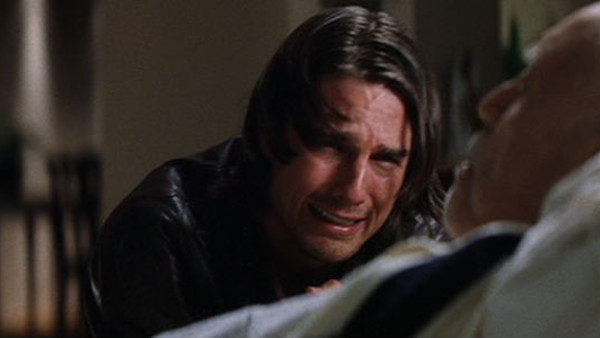
The transformative power of the death experience is demonstrated in the movie, Magnolia (1999) through the character arc of Frank T.J. Mackey, played by Tom Cruise. In the movie, Frank is depicted as an arrogant and misogynistic motivational speaker who disturbingly extolls male dominance, deceit, and even violence, over women to rooms full of misguided men.
Eventually, Frank faces the imminent death of his rich and powerful father, who is revealed to have abandoned Frank and his dying mother, when he was 14 years old, left to face his mother’s death alone. This piece of Frank’s history does not redeem his past transgressions but helps explain his character, who perhaps donned this false tough guy persona to cope with the pain and powerlessness of losing his mother at a young age.
During the father’s death bed scene, Frank unleashes his fury towards his father, first with insults which then dissolves into him lamenting, “I’m not going to cry! I’m not going to cry for you!,” his false armor cracking at the seams, before breaking down with rare show of vulnerability and genuineness. Although the movie does not reveal how Frank’s life turns out, the hope is that the emotional contact with his deeper, true feelings would pave a new path towards leading a more genuine life, but this would first require the dying of his false self.
Death of Me

What is the false self needs to die? A local L.A. artist, Dave Choe, shared his raw perspective to this question during a heart-to-heart conversation about the suicide of his dear friend, Anthony Bourdain:
Here is one hard question people ask me…Tony’s gone now and he’s physically not here with us anymore, and I’m mourning that and so are you, and someone asked me, “if you’re open, can I ask you this question…how much are you mourning Tony being gone and how much are you projecting your own shit onto him of that could be me?” We’re mourning our own death almost…and because of the nature of my work, because how open I am…some kid would reach out to me. “Dave I want to kill myself, I want to kill myself can you help?,” and I always say the same thing, you should definitely kill yourself, and they go “what?” / “No, who are you?” / “Um I’m an artist, I’m a chef, I’m a basketball player.” / “No no no, that’s your profession, who are you? who are you? who are you?” And I go “kill that, whatever you think you are, don’t kill yourself physically, kill your ego of who you think, if you’re going to do it anyways, if you’re’ going to jump off the cliff, shoot yourself, just before you do that, why don’t you kill everything that you believe, and what you thought, and just try something different.” I’ve lived life in such a fuckin bat out of hell just burn it all down, who gives a shit, fuck everything, and the only thing that gave me hope, and hope that’s the thing that gets me through this, and friends and love, is the fact that I can be different tomorrow, I can embrace something I didn’t the day before, that I can change. (Dave Chang podcast Ep 18 1:24 to 1:27)
In the natural course of life, we are able to let go of aspects of our lives that no longer serve or benefit us. However, this is easier said than done. People tend to hold onto what is familiar even though it is detrimental to us, especially when trauma is involved or basic survival needs are dependent on that attachment. Hillman writes that the suicidal impulse enters our lives in these cases of arrested development:
“Under the pressure of ‘too late,’ knowing that life went wrong and there is no longer a way out, suicide offers itself. Then suicide is an urge for hasty transformation. This is not premature death, as medicine might say, but the late reaction to a delayed life which did not transform as it went along. It would die all at once, and now, because it missed its death crises before. This impatience and intolerance reflects a soul that did not keep pace with its life; or, in older people, a life that no longer nourishes with a still-hungering soul.”
Mourning your Death
Actual suicide is devastating, not only for the person who dies by suicide, but the impact on the family, friends, and community who have to bear the grief, confusion, and self-blame of its aftermath. Our lives are so intertwined such that the act of suicide rarely affects only the person who dies by it.
Paradoxically, we must go through with the symbolic suicide of psychological death in order to prevent actual suicide from occurring, “by being the bridge through whom the patient can enter death, the experience may come before the actual death occurs.” Like Tom Sawyer and Huckleberry Finn attending their own funeral, we must witness and mourn the loss of our own self.
Parallel to grieving the loss of a loved one, the mourning may involve honoring the past self that once served us, and perhaps even a ritual to say goodbye to this part of our life, such as writing a goodbye letter or burying an object that symbolized the deceased past self. Like the widow wearing black, changes in a person’s outward appearance can mark the transformation for oneself and others, such as changing one’s hair style, getting a tattoo, redecorating your room, and even going by a different name.
Perhaps the hardest part is facing the emotional pain of the loss, opening the door for despair and agony to enter our hearts. From the perspective of Kubler-Ross’ (2005) stages model that describes the emotional process of grief, denial may lead us to keep ignoring the suicidal impulse, bargaining may keep us in a repetitive cycle of letting go and then reviving the old self as it clings on for dear life, and acceptance may require us to surrender any false hope that we can ever return to our past life. We can remember our past life, but we can no longer live it. Change must happen, and for suicidal clients, their lives may literally depend on it:
“To entertain no false hopes, not even that hope for relief which brings one into analysis in the first place. This is an emptiness of soul and will. It is the condition present form that hour when, for the first time, the patient feels no hope at all for getting better, or even for changing, whatsoever. An analysis leads up to this moment and by constellating this despair lets free the suicidal impulse. Upon this moment of truth the whole work depends, because this is a dying away from the false life and wrong hopes out of which the complaint has come. As is the moment of truth, it is also the moment of despair, because there is no hope.”
Birthing a New Self
Reinvention need not be reserved only for transitional periods of a person’s life, such as starting college or moving to a new area. The possibility of reinvention can happen in every moment of our life, as each moment is unlike any moment that came before.
Because we are creatures of habit, we must first disrupt and extinguish the old patterns that keep us attached to our old self. One way to disrupt these neurologically hard-coded behavioral patterns is to purposely engage in something new, different, and interesting on a regular basis that takes you out of your comfort zone, whether it be something small (e.g., trying a new recipe) or big (e.g., go on a soul-searching trip). The changes at first may feel artificial and uncomfortable but with enough repetition a new normal can be established.
Once the old self is laid to rest and old patterns are disrupted, the work of birthing a new self can begin. In therapy, the birthing process may take the form of a client getting to know themselves better on a deeper level, such as getting in touch with what truly makes them happy or gives them a sense of meaning and purpose, and then actively imagining in great detail what this life would look like. Often therapists ask clients the miracle question, “if a miracle happened that released you from all the problems in your life, what kind of life would you be living?”
Accompaniment
The death experience is meant to be painful, but you don’t have to go through it alone. Just as social support is critical in grieving the loss of a loved one, we are not meant to go through the grief of psychological death alone. I can only dream that one day our society can evolve to be psychologically minded enough to recognize and respect individuals going through this process of soul transformation beset by the suicidal impulse.
While our collective culture has a long way to go, there may be individuals that have the sufficient training and wisdom of life experience to guide and accompany you on this journey. Even though accompaniment doesn’t lessen the pain, having another who is there with you in the depths of your pain has a way of making things more bearable. Accompaniment does not need to come from a therapist, it can come from a partner, a close friend, a family member, a spiritual leader, a support group, etc.. The first step of course is reaching out:
“He [sic] gives the person the opportunity denied everywhere. The analyst now plays the true psychopompos, guider of souls, by not breaking the bond of trust at the moment when it is most crucial…The person knows he can rely on the analyst, because the understanding between them cannot be broken even by death. By having entered the other’s position so fully, the other is no longer isolated.”
Expanding the Emotional Container
Given our society’s “collective dread of death,” we often lack the guidance, training, and experiences to expand our ability to tolerate and hold the emotions associated with the death experience. Often our emotional container is small, and mostly filled with fear when it comes to death. However, this does not need to be the case.
One practical way to desensitizing the fear of death and expand ones emotional container is downloading an app called WeCroak, which sends you a reminder five times a day, “Don’t forget you are going to die,” along with a meaningful quote about death. This practice is based on a Bhutanese folk saying: “to be a happy person, one must contemplate death five times daily.”
Conclusion
Since my father passed away while I was in college, I have gravitated to grief work, first for myself in therapy and a grief support group, and followed by supporting others going through this process. In all the years I’ve run a grief support group, sorrow is probably the most frequent expression of grief, but second to that is not fear, but love, the love for their loved ones who have passed.
In this spirit, putting to rest ones past self can be an expression of love. Loving yourself enough to be willing to face the fear and pain of letting die the parts of your life that no longer serve or benefit you, and having the strength and courage to make fundamental changes in your life to make way for a more fulfilling and congruent life.
References
Hillman, J. (1964). Suicide and the Soul. Dunquin.
Kuber-Ross, E. & Kessler, D. (2005). On Grief and Grieving. Simon and Schuster.
Posted August 29, 2020 by Y. Sue Park. This essay is dedicated to my dear friend and colleague who introduced me to Hillman’s text: Dr. Bryce McDavitt, PhD, a true psychopompos.