April 29, 2021
Broken sticks and broken stones
Will turn to dust just like our bones
It’s words that hurt the most, now isn’t it
–Brandi Carlile
Words can injure
“Go back!” shouted a man derisively at me right outside my car window, followed by a trail of laughter as he briskly walked away. My body froze before my first instinct set in to look behind me. With relief, my five year-old son was sleeping in the back seat, his innocence preserved for another day before the cruelties of the world eventually find their way to him.
Moments prior, we were driving down a quiet road in a rural area, where two men stood on the side about to cross. I stopped my car to allow passage. Instead of crossing, one of the men first walked straight towards the front of my car and then to the side of my driver’s side window, shouting the words that would reverberate in my mind for days to come. The raised window of my car did little to shield me from these words that penetrated the boundaries of my mind, imprinting themselves there.
While a short-lived incident, the images, sounds, and the words, “go back!” echoed through my mind, triggering feelings of anger, fear, and emasculation. From my unconscious arose fantasies of retribution, presumably to soothe my wounded ego and give me an imagined sense of power and control over the situation. There was also doubt and confusion. What if it was my fault? What if I didn’t give them enough space? Yet, even so, was the confrontational and mocking tone warranted?
In the ambiguity of the situation, my mind pondered if my son and I were targets of a racial micro-aggression, which Derald Wing Sue and colleagues define as “brief and commonplace daily verbal, behavioral, or environmental indignities, whether intentional or unintentional, that communicate hostile, derogatory, or negative racial slights and insults towards people of color” (Sue et al., 2007).
According to #stopaapihate, as of February 2021, there has been 3,795 hate incidents against AAPI’s since the start of the pandemic in the U.S. Given this uptick of anti-Asian sentiments, my mind filled in the blanks, “go back to your country, go back coronavirus!”
Words can mislead
Popular opinion attributes the rise in anti-Asian sentiments, in part, to former President Trump who used the words “Kung Flu” and “China virus” to refer to the COVID-19 virus, despite warnings from the World Health Organization that such language would instigate a rise in xenophobia and discrimination against individuals who identify as AAPI.
Trump’s penchant for twisting words to blame and displace responsibility is reminiscent of another master manipulator, Walter White from the TV show Breaking Bad. The character arc of Walter transforms him from an under-accomplished but brilliant high school teacher to a feared king-pin of a drug empire. As Walter falls further into the abyss, he runs out of ways to mislead his wife that everything he did was justified because it was for the family:
“She just won’t understand. I mean, no matter how well I explain it, these days she just has this… this… I mean, I truly believe there exists some combination of words. There must exist certain words in a certain specific order that can explain all of this, but with her I just can’t ever seem to find them.”
Walter doesn’t realize at the time that he had fallen prey to the complex web of lies of his own creation, and foolishly thinking more words “in a certain specific order” can somehow save him. It is not only after he has lost everything dear to him, a humbled Walter admits to Skyler that he now realizes he has not been doing it for the family, but selfishly for himself.

Like Walter caught in his own web of lies, words can spin narratives to propagate certain political and social agendas that can engulf not only individuals but a whole country. Given that the U.S. has been embroiled in a trade war with China, that the first known case of COVID-19 was from Wuhan, China, and that the previous administration failed to effectively manage the pandemic, it is no surprise that Asians were an easy target for scapegoating. Furthermore, given how emotionally-destabilizing the pandemic has been, Americans’ may have been more susceptible to being mislead by tactics that manipulate our emotional responses and undermine our cognitive capacity to examine these messages in a critical and balanced way.
Words can condemn
Returning to the incident, I observed my anger and fear triggering a black-and-white mindset, pushing me to condemn this man as a “racist.” However, doing so would go against my psychological training that views humans as complex, multi-faceted and constantly evolving. Who knows, this man may have intersecting identities associated with non-privilege and oppression. Labeling this man as a “racist” would flatten his life into a one-dimensional “bad” that over-simplifies and over-generalizes.
More insidious, labeling him as a “racist” would turn him into an “enemy,” disturbing my peace of mind and propagating a sense of conflict and division with an undifferentiated stranger that can be confused with any other stranger. Nelson Mandela, from the wisdom he gained from healing the deep wounds perpetrated by the Apartheid, stated that “resentment is like drinking poison and then hoping it will kill your enemies.”
To let go of my anger, I made a conscious intention to see this man as a misguided neighbor rather than an enemy, while still recognizing his behavior as problematic, but not necessarily his person-hood. This distinction was helpful to me because behaviors are learned, which means that they can be unlearned. And while we are responsible for our behaviors, they do not define us.

Words can heal
Despite the unreality of ever reconciling with this man in real life, I realized that in order for me to regain my peace of mind and sense of safety, I needed to reconcile with the mental image of this man who exists in my subjective reality, even if it were to be imagined. Our psyche has the unconscious tendency to create mental images of people and things in our lives, and these mental images have a way of tormenting us even though the actual person or thing has long departed, often in critical or fearful voices disguised as our own.
From this perspective, I returned to the site of the incident and purposely imagined reconciling with this man.
Me: Hey man, that day we first met, I was really hurt by what happened. I experienced you shouting at me and that made me feel unsafe. My son was also in the car, so I felt very protective of him. I don’t know if it was my fault, whether or not I didn’t stop my car in time. In that case, I’m sorry. At the same time, I have been questioning if you reacted in that way because I am Asian.
Other: I’m glad we have this chance to talk. The situation has also been weighing on me. I don’t know what came over me, but I appreciate the feedback. I’m really sorry that I reacted in that way and made you feel unsafe. I feel so bad that your son was there. I need to learn from this and do better.
The words “I’m sorry” has a way of making it easier to forgive and move on, releasing the anger and resentment we may hold for one another. Despite the power of “I’m sorry,” many people struggle saying these simple words, perhaps out of fear of the apology being rejected or giving the other person the opening to judge and/or punish them for their admission of guilt. Esther Perel, a respected sex psychologist, says that it is usually the more secure one in a relationship who is able to say sorry first. The vulnerability of being the first one to say “I’m sorry” can be scary, but the courage to do so can make way for forgiveness, reconciliation, and peace.
Words can embolden
Weeks after my incident, an unspeakable mass shooting occurred in Atlanta, Georgia in which eight people were murdered, six of whom were AAPI women. The incident shook the country but especially AAPIs whose shared identity was the target of the shooting. The AAPI women who were murdered were not just strangers, they were members of our community, and in them, we saw our mothers, wives, and daughters.
After the incident, adding insult to injury, the sheriff in charge of investigating the incident, rationalized the shooter by saying he was just having a “really bad day” and appeared to victim blame noting that spas that these women worked at were places of “temptation” for the shooter who struggled with “sexual addiction.”
These words by the sheriff mirrored the words spoken by a Judge who in 1982 oversaw the case of Vincent Chin, a young Chinese man who was bludgeoned to death at the hands of two disgruntled White auto-workers who presumably blamed Asians for the declining jobs in the American auto-industry due to competition from Japanese auto-makers. It didn’t matter that Vincent was Chinese and not Japanese. The Judge stated, “they weren’t the kind of men you send to jail,” to justify the ruling that these men would serve no jail time and instead be placed on probation and fined $3,000. This apparently was what an AAPI’s life was worth back then in 1982.
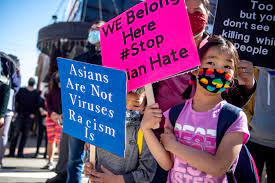
Fast forward almost 40 years, the response from the AAPI community in response to the Atlanta mass shooting was swift and forceful. Defying traditional Asian values around maintaining harmony and avoidance of making waves, many AAPI, especially youth, called for the community to “speak up and speak out,” resulting in AAPI’s sharing their stories of non-inclusion, invisibility and discrimination, challenging the stereotypes of AAPI’s being model minorities or perpetual foreigners, and staking claim to our right as Americans to not only have a voice but be heard.
Moreover, AAPI’s and their allies pushed for attributing the words “hate crime” to the Atlanta mass shooting as well as countless other Anti-Asian incidents. While this label does not redeem the tragedy and trauma of the shooting, the words have great symbolic meaning, conveying that hateful actions towards AAPI’s is a crime punishable by law. On a legislative level, this push resulted in the recent passing of the COVID-19 Hate Crimes Act that passed overwhelmingly (94 to 1) with a rare show of bi-partisan support that would expedite the investigations of hate crimes against AAPI’s, raise awareness around hate crimes, and the establish a hate crime reporting system.
Words can enlighten
The clarion call to “speak up and speak out” sheds light on both the contemporary struggles of AAPIs but also the long history of AAPI discrimination and non-inclusion, such as a Chinese Exclusion Act and Japanese internship, which has been intentionally or unintentionally washed over by the Model Minority stereotype that was perpetuated in the 1960’s, pitting AAPI’s against other minority groups.
On a psychological level, the act of finding words to express our struggles may help AAPI’s gain clarity on their own experiences of discrimination and micro-aggressions that are often ambiguous and confusing. Given traditional Asian values around saving face (e.g., maintaining positive social image), and emotional self-restraint especially of negative emotions, many AAPI’s may suffer through these experiences alone in private, while suppressing and/or ignoring the negative emotions that may arise.
When faced with strong negative emotions, Daniel Siegel, a professor at UCLA, has a popular catch phrase, “you have to name it to tame it.” This suggestion is based on neuroscientific finding that when we experience trauma or some other painful emotional event, our emotional brain (i.e., limbic system) becomes dominant and partially turns off the pre-frontal cortex, which is the seat of our conscious thinking.
This state is akin to being “emotionally hijacked” in which strong negative emotions can take possession over us, leaving us at the whims of emotional reactivity and impulsiveness, as well as our pre-programmed fight/flight/freeze responses that are meant to keep us safe but more likely to hinder a constructive response. However, when we find words to label these emotions, we put our conscious brain back online, which allows us to make sense of the traumatic event in a more coherent way, and respond with intention, reason, and equanimity (Van der Kolk, 2015).
Words have power
Witnessing the courage of the other AAPI’s speaking up and being vulnerable about their struggles inspired me to share with my work community. Previously, I had kept my story mostly private, and tucked away the incident as a valuable learning experience that can help me empathize with clients who have experienced similar and more likely worse incidents of discrimination.
Sharing my story was nerve wracking, having to face the discomfort of having the spotlight on me, guilt over taking up group space, and fear of rejection, judgment, and invalidation. Despite my fears, my community responded with words of understanding and support, which helped me feel safe and protected. These words touched my heart and instilled a sense of belonging and a feeling cared for.
Even though my community is not always around, the words have stayed with me beyond space and time, allowing me to feel safe in my identity as an AAPI in a country that is continually in the process of reckoning its troubled history of racial injustices. I hope this process will make way for a more equitable, just, and inclusive multi-cultural society. Genuine words from the heart, messy and not in a “certain specific order,” can help get us there.
References
Sue, D. W., Capodilupo, C. M., Torino, G. C., Bucceri, J. M., Holder, A. M. B., Nadal, K. L., & Esquilin, M. (2007). Racial micro-aggressions in every day: Implications for clinical practice. American Psychologist, 62, 271-286.
Van der Kolk, B. (2015). The body keeps the score. Penguin.
Posted April 29, 2021 by Y. Sue Park. This essay pays homage to the anniversary of the L.A. Riots, referred to by Korean Americans as “Sa-I-Gu” (4-2-9). While a traumatic event, it woke many Korean Americans to the harsh reality of a racialized America, galvanized the Korean American identity and community, and was the precipice for Black and Korean Americans working together to improve their relations.